
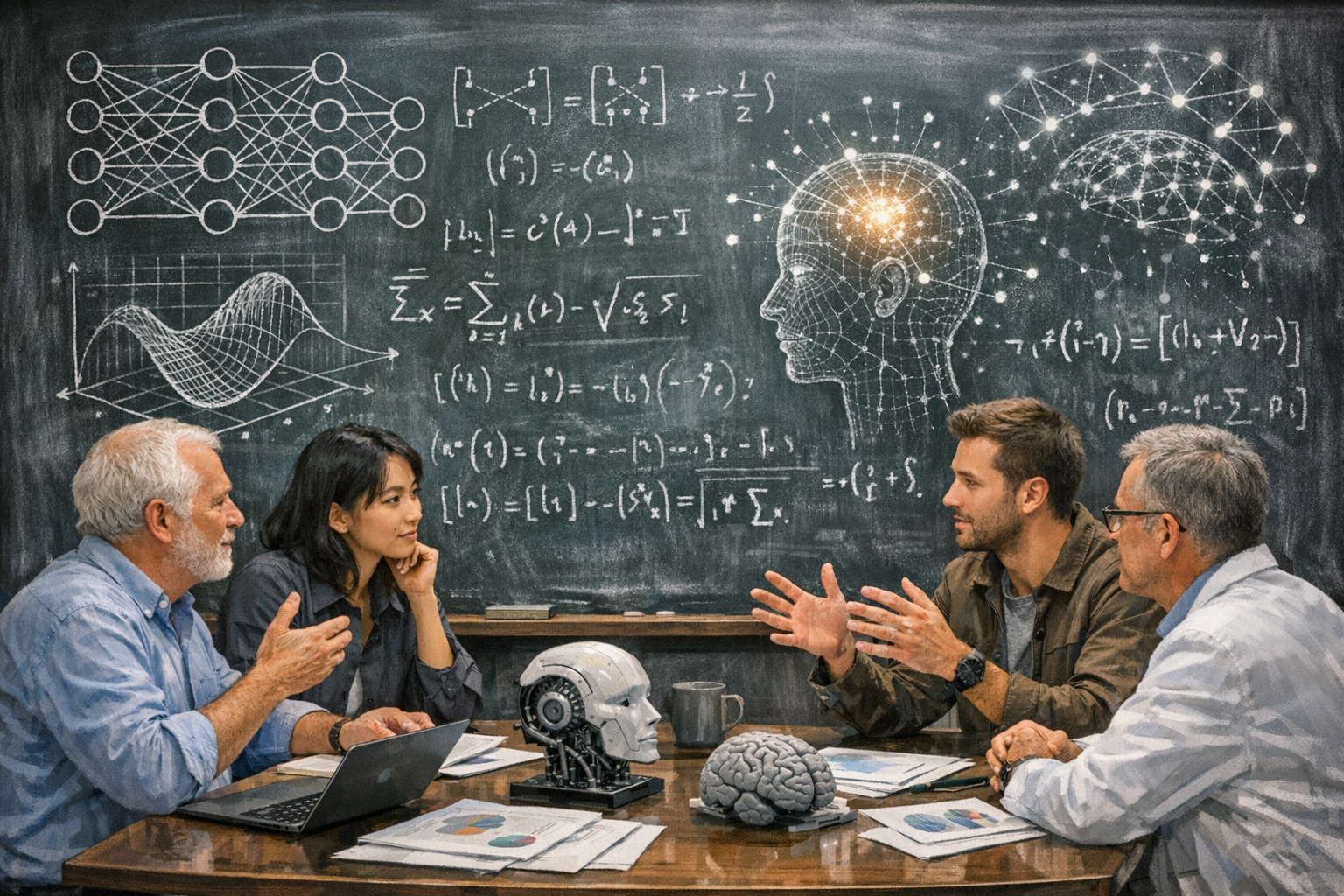
AI’s Math Breakthrough: Astra’s 10 Advances
Astra’s latest reveal is not just a proof-of-concept moment for AI in mathematics; it’s a signal that the frontier is shifting—from simple problem-solving to broad, verifiable mathematical influence. Researchers, policymakers, and developers are watching closely as OpenAI showcases what happens when a frontier AI model tackles deep math in a single, audacious release.
Index
| Section | Link |
|---|---|
| 1. Astra’s Bombshell: What Was Announced | #Astra’s-Bombshell-What-Was-Announced |
| 2. Why This Could Reshape Math & Science | #Why-This-Could-Reshape-Math–Science |
| 3. The Debate: Proof, Verification, and Attribution | #The-Debate-Proof–Verification–Attribution |
| 4. What’s Next for AI in Pure Math | #What’s-Next-for-AI-in-Pure-Math |
| 5. Takeaways for Practitioners & Decision-Makers | #Takeaways-for-Practitioners–Decision-Makers |
Astra’s Bombshell: What Was Announced
OpenAI’s researchers rolled out a blog detailing ten mathematical advances achieved by their frontier model, Astra. The release frames these as breakthroughs across several domains—some touching number theory, algebraic geometry, and computational proofs. To many observers, the list reads like a curated tour of problems long considered hard enough to test the mettle of the strongest human teams. If even a subset of these advances stands up to independent scrutiny, the implications ripple across academia, software tooling, and how labs present research progress.
\n\n\n\n
Beyond the sheer novelty, the package signals a broader capability: AI systems that can reason about complex mathematical structures, propose conjectures, outline proofs, and, in some cases, draft proofs that can be checked by formal proof assistants. The engineering behind Astra—training regimes, prompt engineering strategies, and verification workflows—will now be under the microscope as researchers try to replicate or extend the results. For AI developers, the question becomes not only what the model can do, but how reliably it can be guided to do the right thing in rigorous mathematical contexts.
Why This Could Reshape Math & Science
The potential ripple effects are wide. For mathematics, a field long defined by human-centric proofs and peer review, an AI that can contribute to proofs may accelerate discovery, democratize access to advanced problem-solving, and foster new collaborative workflows between humans and machines. For applied sciences, these advances could translate into faster validation of theoretical results, new heuristics for algorithm design, and a rethinking of what “proof” means in practice when tools can assist at scale.
- Verification becomes key: a dominant theme is how to verify AI-generated proofs. Lean, Coq, and other proof assistants may become more central as researchers seek formal guarantees alongside human intuition.
- Collaboration models shift: mathematicians may lean on AI as a cognitive partner to explore conjectures, test edge cases, and draft structured outlines for proofs, while preserving critical human oversight.
- Attribution and credit: debates about who deserves credit for breakthroughs—labs, researchers, or the AI systems that assisted—will push new norms in publication and citation.
\n\n\n\n
The Debate: Proof, Verification, and Attribution
As with any sweeping claim, Astra’s math breakthroughs invite healthy skepticism. Experts are quick to note that a model’s ability to “solve” a problem is not the same as a human-proof demonstration that others can reproduce and verify. The technology’s current state raises urgent questions: Can an AI-generated proof be parsed, checked, and built upon by human mathematicians as reliably as a proof drafted by a skilled researcher? Do the model’s prompts and prompting-aiders introduce subtle biases in the way problems are framed or approached?
Attribution is another flashpoint. If a proof or method arises from AI-assisted exploration, how should credit be allocated? Will journals require disclosure of AI involvement, and will formal proofs need to be Lean-verified or similar? The open questions are not just philosophical; they will shape how resources are allocated, how funding models adapt, and how students are trained to work alongside increasingly capable AI researchers.
What’s Next for AI in Pure Math
The Astra release offers a glimpse of a near-future: AI systems that participate in foundational questions, not just tool-building or data processing. Expect a four-part evolution:
- More robust verification pipelines that pair human insight with machine-generated progress.
- Greater transparency around how models approach proofs and how results are validated.
- New workflows in journals, conferences, and preprint servers that accommodate AI-assisted contributions.
- Expanded collaboration between AI labs and pure-math communities to identify where AI can meaningfully accelerate breakthroughs without compromising rigor.
For practitioners and decision-makers, the key takeaway is strategic: invest in robust verification ecosystems, foster transparent disclosure practices, and support cross-disciplinary collaboration to capture AI-driven momentum while preserving foundational scientific standards.
In the months ahead, we’ll likely see more detailed analyses from The Verge, VentureBeat, and other outlets exploring Astra’s exact breakthroughs, their proofs, and the reproducibility of those results. The conversation isn’t just about one list of ten problems; it’s about how the science community will integrate AI-driven reasoning into the heart of mathematical discovery.
If Astra’s trajectory holds, we may be witnessing the early chapters of a long collaboration between human intuition and machine rigor that could redefine how math—and perhaps science—moves forward.